









When the Brain Speaks in Sentences: AI and the Rise of Mind Captioning

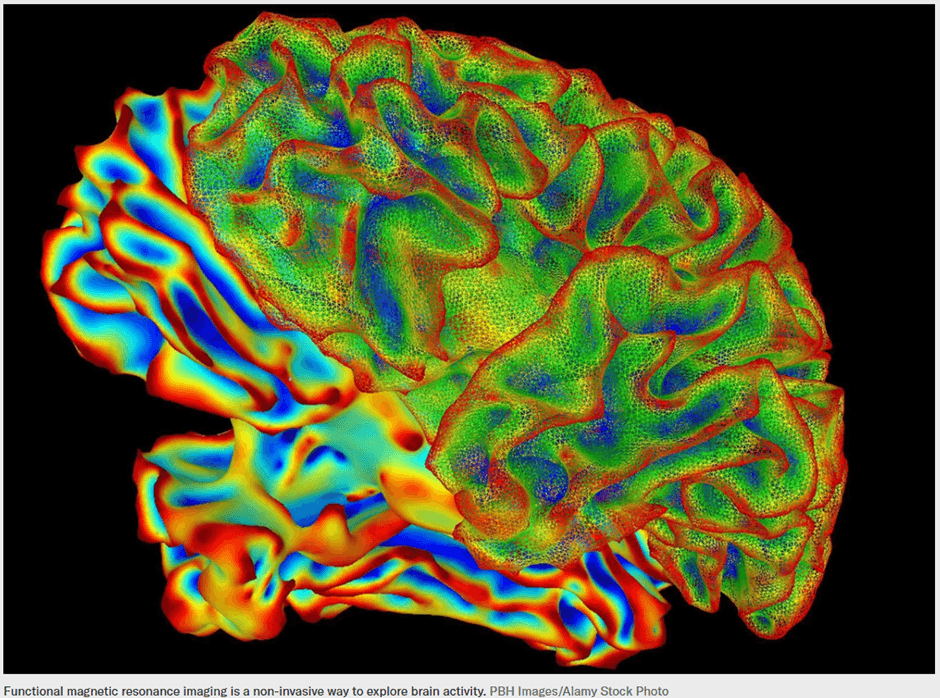
For decades, neuroscientists have attempted to peer into the brain and translate neural activity into understandable signals. While earlier research could roughly predict what a person was seeing or hearing, converting rich mental experiences into coherent language remained beyond reach. The gap between raw brain signals and meaningful sentences seemed too wide to bridge.
Recent advances in artificial intelligence, however, are beginning to close this gap. A new technique known as mind captioning suggests that the brain represents meaning in a structured form even before it is transformed into spoken or written language.
From Brain Signals to Meaning Signatures
The breakthrough approach, described in Science Advances, relies on a two-stage AI framework.
First, researchers used a deep-language model to analyze captions from more than 2,000 videos. Each caption was converted into a numerical representation, or meaning signature, capturing its semantic content rather than its exact wording. In parallel, a second AI model was trained on functional MRI data collected while participants watched these videos. This model learned to associate specific patterns of brain activity with the corresponding meaning signatures.
Once trained, the system could decode previously unseen brain scans and reconstruct detailed descriptions of new visual scenes.
Beyond Keywords: Capturing Context and Intent
What distinguishes mind captioning from earlier decoding methods is its ability to generate full contextual descriptions instead of isolated words.
When participants watched a clip of a person jumping off a waterfall, the AI initially produced vague guesses. As more neural information was processed, the output gradually converged into a sentence closely matching the actual scene. Remarkably, similar results were achieved when participants simply recalled the videos from memory, suggesting that the brain encodes meaning in a comparable way during both perception and imagination.
This finding offers new insight into how abstract meaning is represented in the brain, independent of sensory input.
Implications for Communication and Medicine
The potential applications of mind captioning are significant.
For individuals with speech impairments, stroke-related language loss, or neurodegenerative conditions, this technology could provide a new channel for communication, allowing thoughts or mental images to be expressed as language. Beyond clinical use, the research also deepens our understanding of how cognition, imagination, and language are interconnected at a neural level.
The Ethical Boundary: Protecting Mental Privacy
Despite its promise, mind captioning raises profound ethical questions.
The ability to translate brain activity into language brings concerns about mental privacy, consent, and misuse. Researchers emphasize that such systems must be deployed responsibly, with strict safeguards to ensure that neural data is accessed only with informed and voluntary participation. As decoding methods improve, protecting the autonomy and privacy of individuals will be just as important as advancing the technology itself.
Conclusion: A New Window into Human Thought
Mind captioning represents a major step toward understanding how the brain transforms experience into meaning. By revealing that structured semantic representations exist before language, this research challenges long-held assumptions about cognition and communication.
As artificial intelligence continues to evolve, it is not only enabling machines to understand us better, it is helping us understand ourselves. The future of this field will depend not just on technical progress, but on how carefully we navigate the ethical boundaries of reading the human mind.
References
- https://www.science.org/doi/10.1126/sciadv.adw1464 Science
- https://www.nature.com/articles/d41586-025-03624-1 Nature
- https://www.scientificamerican.com/article/ai-decodes-visual-brain-activity-and-writes-captions-for-it/ Scientific American
- https://www.medicalxpress.com/news/2025-11-mind-captioning-technique-human-thoughts.html Medical Xpress